
The more I read about Satsuki azalea, the more interesting it tends to become. I already was aware that, due to its different requirements in care taking, Satsuki is a very different branch in the bonsai growers industry, with its own rules and depth in quality appreciation. You can follow the progression of my personal collection here.
Satsuki with its approx. 5000 variants is only one of the many cultivars of Azalea, 20 of which you can find in the azalea database by Mark Nijland.
To emphasize their beautiful bloom, rather than developing a more interesting bonsai shape, Satsuki tend to be grown into so called "flower towers".
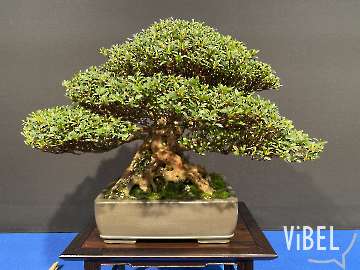
My favourites though are in fact those well shaped -mostly as moyogi (informal upright) styled- ones, for their magestic foliage and bark colour combination, where the flowers come as a plus. After all, it only takes 30 years to style one.
Peter Warren, a reknowned UK based Satsuki bonsai specialist, stresses to choose well, for the flower tower variaties are not at all suited to be shaped into a "classical" bonsai style.
How Azalea's are Different
They are
- bottom dominant, whereas most decidious trees are top dominant. Basically because they are not trees, but shrubs. Building and maintaining the apex is more delicate and top growth tends to require special attention.
- favouring kanuma soil, a clay based acidic substrate with fine pores, suiting their fine hairy root system. Although most sources suggest a 100% kanuma mix, Danny Use of Ginkgo Bonsai recommends to mix it with akadama, because kanuma based Satsuki bonsai tend to show foliage deficits and health issues in our North-European climate.
- sensitive at their root core. So, preferably leave the root ball below the stem untouched, or handle with extreme care, when repotting or doing root work.
However, when growing satsuki as shohin, Japanese sources mainly recommend to clean the root core with water or a water gun. This is worth checking out.
Which Satsuki Azalea to Shape as Bonsai ?
The approx. 5000 Satsuki varieties are classified by their flower size, flower pattern and colors and leaf size. Small flowers generally also indicate a small leaf size.
( [C]-marked Satsuki are the ones I take care of in my collection)
XS - Extra Small or Tiny Sized Satsuki (up to 3 cm)
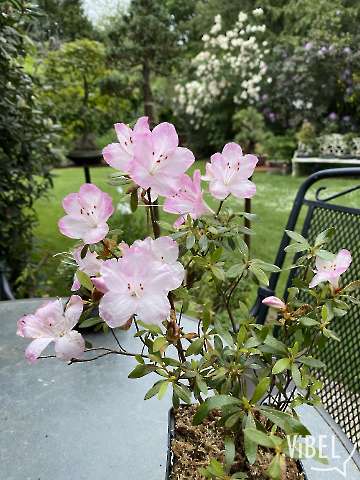
Tiny sized or extra-small flowering Satsuki are Senbazuru, Kotaro, Hoshi-no-Kagayaki, Miyamamangetsu [C], Kosuzu, Kakuou.
S - Small Sized Satsuki (3-5 cm)
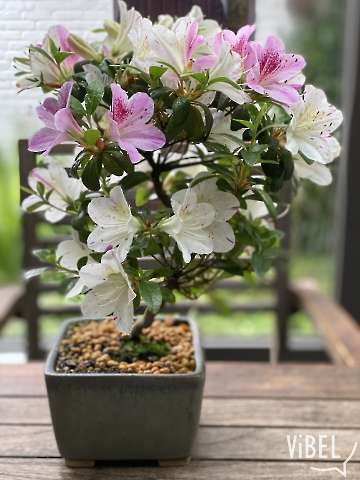
Small sized flowers with small leaves are the ones preferred for bonsai shaping: Secchu-no-Matsu (white), Kinsai (+++), Chojuho, Hinomaru (+++), Matsunami (+++), Korin, Aozora, Momoka, Kozan, Nikko [C] (+++).
Well known small leaf sized Satsuki (<2 cm) are Kotaro, Kazan, Shugetsu
M - Average / Medium Sized Satsuki (5-7 cm)
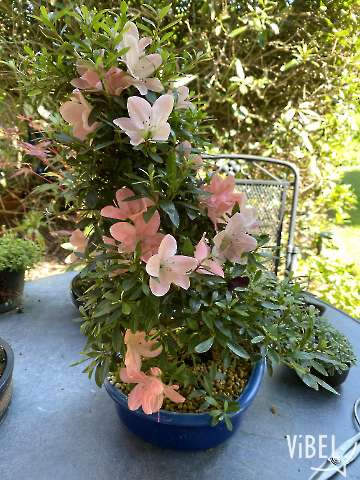
Osakazuki is considered the basis of all Satsuki azalea. Other welll known medium sized Satsuki are Yata-no-Kagami, Gyokurei, Kougetsu, Kunpuu, Kikouchi, Kobai, Suzu-no-Homare, Akemi-no-Tsuki [C], Kaminoyamakirin [C], Kinu-no-Mai, Shien, Wakaebisu.
L - Large Sized Satsuki Flowers (7-10 cm)
Large Sized Satsuki flowers are Koka, Suisen, Asuka [C], Kaho, Izayoi, Issho-no-Haru, Yama-no-Hikari.
H - Huge Sized Kiodairin Satsuki (10-15 cm)
Satsuki with flowers sized above 10 cm are called a "Kiodairin", such as Meicho, Daisetsuzan, Benigasa, Shinkigen. Giant Satsuki are rare and hard to find.
The most famous satsuki are listed with pictures at azaleadatabase.com, where you can also read a truly valuable article about which cultivars are best suited for bonsai.
Comments