
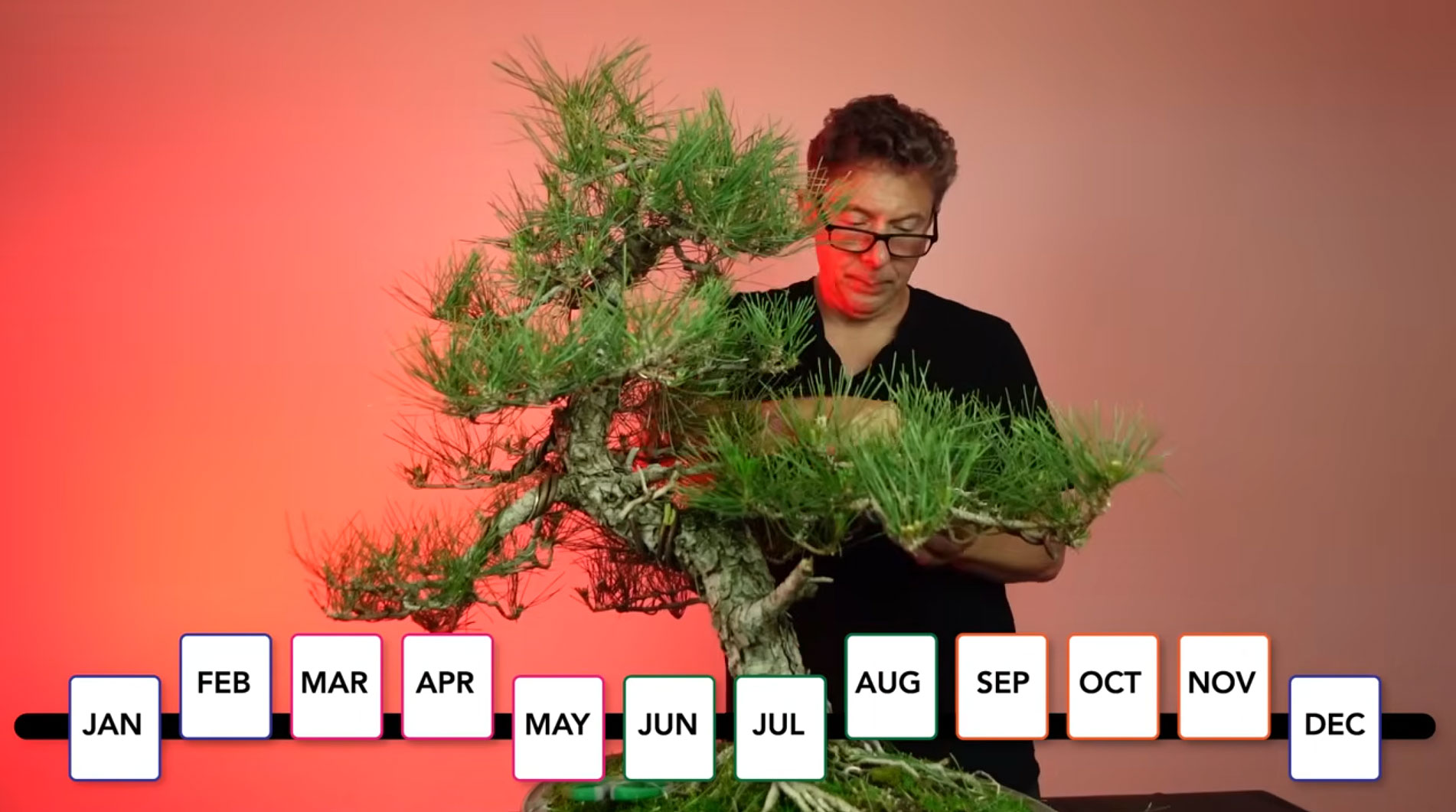
A picture tells more than 1000 words. This one shows you when to prune black pine needles and stop fertilizing (May in our northern hemisphere) and then when to start fertilizing again AFTER the new buds have formed and hardened off.
Courtesy of @MakeMoreBonsai
https://youtu.be/uE3L-DVHEug?si=rEgRe-XTPAYRfkQP
The idea of this article is that it grows, while sharing my research findings and insights in handling Japanese black pines (kuromatsu).
Repotting & Root Pruning of Double Flush Pines
The best time to repot double flush pines is in very early spring when the buds start swelling (when they do, they start changing color). Be conservative on root pruning to not weaken the root system when we start decandling later in summer. So don't remove more than 30-40% max of the root system. Be even more conservative on older trees and keep root pruning below 20-30%.
Remove up to 70% of the soil and protect the 'shin' (pronounced as ~sheen~) -which are the roots directly under the trunk- as much as possible.
Substrate for Pines
Use a standard mix of
- 1 part akadama
- 1 part pumice
- 1 part lava rock
- 1 part kiryu
Young trees that need a lot of growing to do, will be just fine in a standard potting mix.
Heavy Fertilizing in Spring
Start fertilizing heavily at the very beginning of spring.
Trees in early development will do great on a high percentage of Nitrogen. Here in the BeNeLux (North Europe) we would typically use Substral Universeel with Osmocote NPK 22-7-14 (2.5) with Copper & Iron, whereas the standard in the US would be Osmocote Plus with NPK 15-9-12 or Micracle Gro.
Shift to organic fertilizing for trees in mid development and onward, where the primary branches are already set and the focus has shifted to secondary & tertiary branch development, Biogold or equivalent fertilizers come highly recommended.
Heavy fertilizing means to ad 33% up to doubling the amount of fertilizer then you would with other trees. The reason why we try to pump the trees up with heavy fertilising in spring is to make them very healthy for decandling in summer.
No Pruning & Styling in Spring
Pruning & wiring is something we avoid doing in spring. You would only weaken the tree and risk to knocking any buds that are forming.
We only prune and style our double flush pines after the summer.
Summer is Pine Time
Mid summer is the time we start decandling pines, whereas wiring and styling is preferably done in early autumn.
According to Hilma Hiruma-san of BonsaiQ, from his expeprience in Japan, late June is his absolute best time for hard-bending pines. In our climate in the BeNeLux, that would be a match with early to mid July.
Comments